Student Scientific Circle of Epigenetics and Medical Nanotechnology “EPIGENiusz”
Supervisors:
Dr. Anna Jagusiak,
Dr. Paulina Dudzik,
Dr. Kinga Kocemba-Pilarczyk,
The student research group, operating at the Department of Medical Biochemistry, focuses on epigenetics and nanotechnology in medicine and offers opportunities for development in these two areas.
The student research group offers participation in research projects that will allow students to gain valuable experience, as well as the opportunity to attend conferences and publish scientific papers. To make this possible, a space has been created for students of all years of study (II-VI) to pursue their own research ideas. The Student Research Group of Epigenetics and Nanotechnology in Medicine is a place where science meets innovation, theory meets practical skills that can impact the future of medicine.
Dr. Anna Jagusiak’s research focuses on the creation of drug carriers based on carbon nanotubes, self-associating ribbon systems, and innovative systems for delivering chemotherapeutic agents to cancer cells using immunotargeting, which will enable the development of treatment methods complementing traditional surgical techniques. Another key area of research is epigenetics.
Dr. Paulina Dudzik is searching for markers that can support early disease diagnosis.
Research activities:
- Cell cultures
- Assessment of apoptosis and necrosis
- Proliferation assessment assays
- Metabolic assays Isolation of genetic material
- Protein expression assays using
- Western blots
- Gene expression assays using RT-PCR
- DNA methylation assessment using BGS
- Design of PCR primers
- Assessment of carrier-drug interactions using electrophoresis, dynamic light scattering, hemagglutination assays, spectrophotometric, dialysis, and microscopic methods.
The educational aspect implemented in the The Student Research Group Epigeniusz deserves special attention. Dr. Paulina Dudzik and Dr. Kinga Kocemba-Pilarczyk intend to promote an innovative project related to peer tutoring among students. As a result of the cooperation between KBL employees and student tutors, on the basis of surveys, two conference applications were created at international scientific and didactic conferences. This academic year, students involved in SKN EPIGENiusz will take part in courses and courses, both in Poland (Collegium Wratislaviense, certified course) and in the Netherlands (Universtytet Groningen, study visit combined with training), improving their communication, didactic, organizational and social competences. The results of the research will be presented at the International Didactic Conference AMEE (Association for Medical Education in Europe) – (Vienna 2026). The project is funded by the EU.
The EPIGENiusz Scientific circle is just beginning its activities, but we are already creating a space that fosters scientific development. In the current academic year, our Scientific Circle is developing extremely dynamically. We have received support under the ministerial programme „Support for students in improving their competences and skills” (Invitation of the Minister of Science and Higher Education – call II, no. FERS.01.05-IP.08-0217/23), thanks to which we are implementing three student research projects.
1. Wiktoria Ziółek conducts research on oncology as part of: Support for a medical student, actively involved in oncological activities, in order to improve her competences and skills in the international environment – co-financing amount: PLN 37,356;
2. Kamil Sobieszek conducts research on oxidative stress as part of the project: Rosa rugosa extracts as potential anti-cancer agents: role in modulating oxidative stress – co-financing amount: PLN 21,406;
3. Students from the SKN EPIGENiusz circle carry out the project: Support for students of SKN Epigenetics and Nanotechnology in medicine in the field of improving their competences on the international arena through participation in scientific projects and peer tutoring – co-financing amount: PLN 244,152;
This year, we are also developing an extended peer-to-peer tutoring program. As part of it, medical students formulate research questions and biological problems, while bioinformatics students support them using data analysis, specialized databases and computational tools. The program is implemented in cooperation with members of SKN In Silico at the Jagiellonian University Medical Center, thanks to which we create a friendly, dynamic and practical environment of project work, in which both groups learn from each other, complement each other’s competencies and gain real, interdisciplinary experience — combining the world of medicine, biologyi i bioinformatics.
We plan to organize workshops and educational meetings for primary and secondary school students. We also want to actively participate in science-popularization events, such as the Science Festival and the Małopolska Researchers’ Night. Our goal is to inspire young people and share our passion for science!
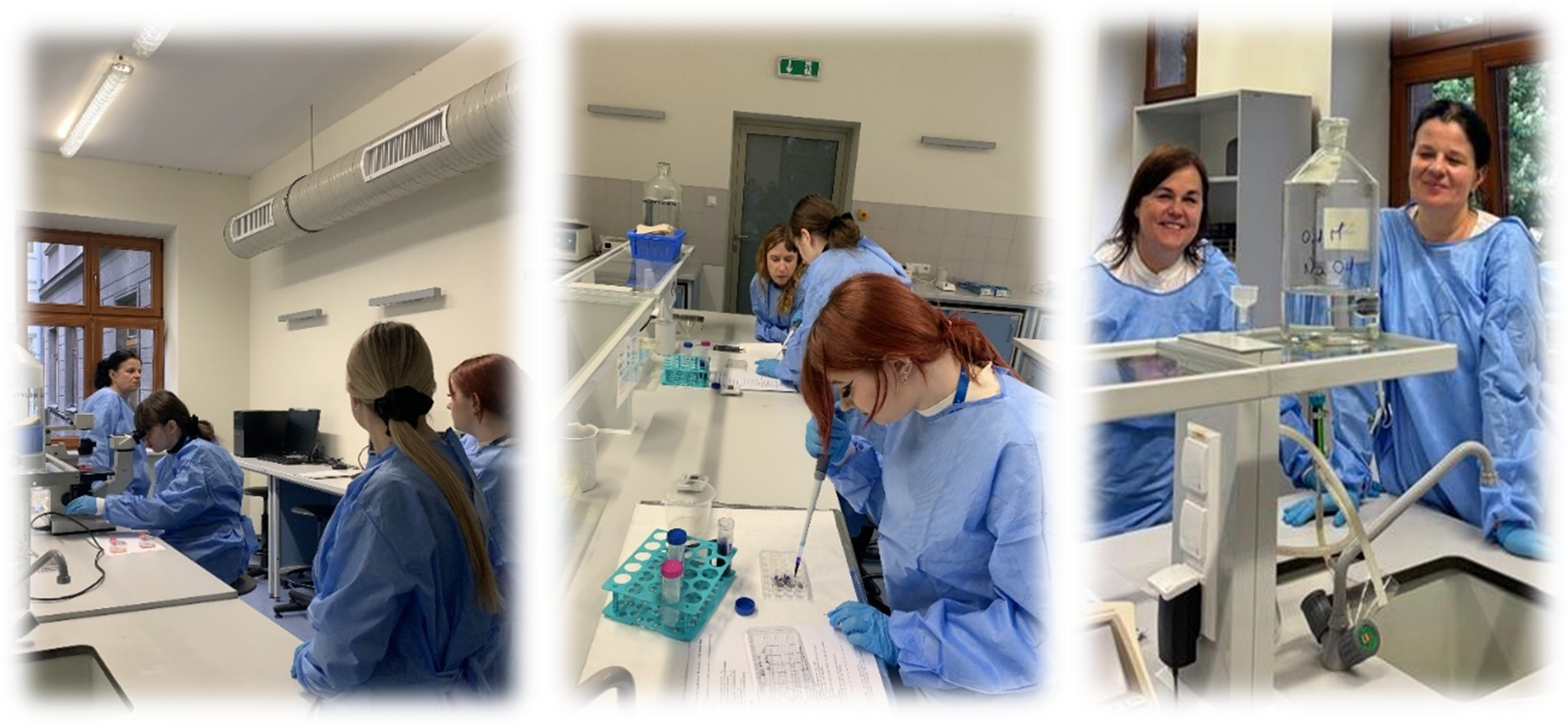
On 24-26.04.2025, the 33rd International Medical Students’ Conference, organized by the Student Scientific Society of the Jagiellonian University, took place in Krakow. At the request of the organizers, workshops related to in vitro culture of cancer cells were prepared in the laboratories of the Department of Medical Biochemistry. Students had the opportunity to independently conduct cytotoxicity tests (MTT, crystal violet) and talk about research conducted at the Department of Medical Biochemistry.
The English division unites motivated medical students interested in connecting preclinical science with clinical application. Our division is a collaborative, international group that welcomes medical students from 2nd to 6th year, bringing together diverse perspectives and experiences from across the globe to learn, research, and grow together. Focusing on molecular and biochemical aspects of translational medicine, our group offers opportunities for research participation, scientific writing, and skill development. We also organize workshops exploring the clinical relevance of preclinical subjects, especially biochemistry, to help students understand how fundamental science shapes medical practice.
Chairwoman of the group: Jadwiga Duda (4th year MD) jadwiga.duda@student.uj.edu.pl
Chairwoman of the English division: Rakel Trevor (2nd year MD) rakel.trevor@student.uj.edu.pl